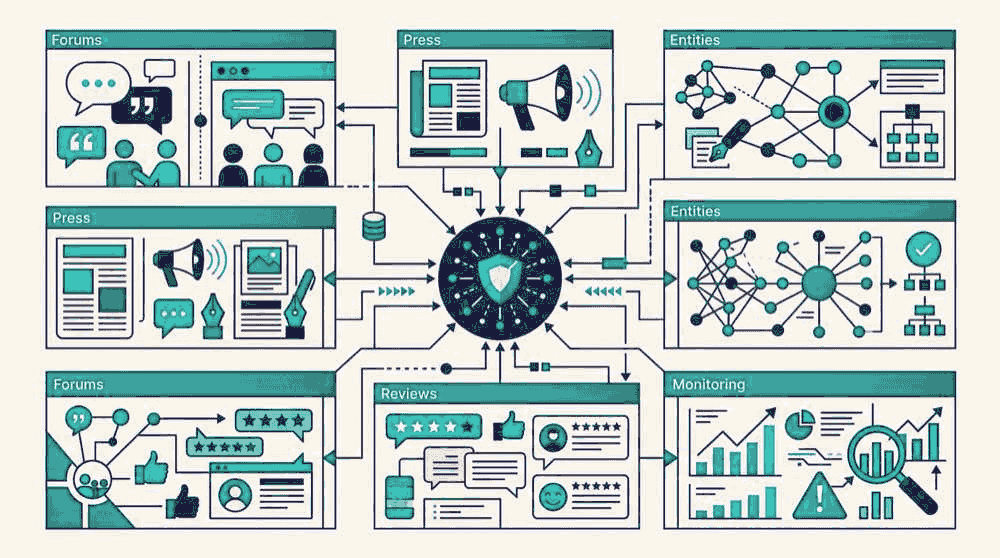
What Is Generative Engine Optimization (GEO)? The Complete Guide for 2026
GEO is the practice of optimizing your brand to be recommended by AI models. This comprehensive guide covers the 6-pillar framework, strategy, execution, and measurement.

GEO is the practice of optimizing your brand to be recommended by AI models like ChatGPT, Perplexity, Gemini, and Claude. It works across 6 pillars: AI Presence, Entities, Reviews, On-Page, Citations, and Press. This guide covers everything from strategy to execution.
What Is GEO and Why Does It Matter?
Generative Engine Optimization (GEO) is the practice of optimizing your brand’s presence across the information sources that AI models use to generate recommendations. When someone asks ChatGPT "What’s the best accounting software for freelancers?" and the response recommends FreshBooks, QuickBooks, and Wave — GEO is why those specific brands appear. It’s the discipline of ensuring your brand is part of the AI’s answer.
GEO is distinct from traditional SEO, though they share common foundations. SEO optimizes your website to rank in search engine results. GEO optimizes your brand’s entire digital footprint to be recommended by generative AI models. The difference matters because AI models don’t generate recommendations the same way Google ranks pages. Google follows links and scores relevance. AI models synthesize information from across the internet — Reddit, reviews, Wikipedia, press coverage, schema data — to build a consensus understanding of which brands are credible, relevant, and recommended.
GEO is also distinct from Answer Engine Optimization (AEO), which focused primarily on featured snippets and voice search in the pre-AI era. AEO was about structuring your content so Google could extract direct answers. GEO is broader — it’s about influencing the entire consensus layer that AI models reference, not just structuring your own content. Some people also use the term LLMO (Large Language Model Optimization), which is essentially the same concept as GEO but with a narrower focus on the models themselves rather than the information ecosystem they draw from.
The "why now" case is overwhelming. AI-referred sessions grew 527% year-over-year across tracked websites. Zero-click searches have reached 83%, meaning most people never click through to a website from search results. Google’s AI Overviews now appear in 48% of queries, and when they do, traditional organic click-through rates drop by 34.5%. Meanwhile, 37% of consumers report starting their search journey with an AI tool rather than Google. Among younger demographics, it’s over 50%. The shift from "I rank on Google" to "AI recommends me" isn’t theoretical. It’s measurable, accelerating, and directly impacting revenue for businesses that pay attention.
The fundamental paradigm shift is from ranking to being recommended. In the Google era, you competed for positions on a results page. In the AI era, you compete to be part of a curated recommendation. There’s no "position 7" in a ChatGPT response — you’re either recommended or you’re not. The brand that the AI mentions first has a dramatic advantage over the brand mentioned third, and brands not mentioned at all are invisible. This winner-take-most dynamic makes GEO not just important but urgent.
How AI Models Build Their Understanding of Brands
To optimize for AI recommendations, you need to understand how AI models form their understanding of brands. It’s not magic, and it’s not random. AI models build what I call a consensus layer — a synthesized understanding of what the internet collectively says about your brand, your competitors, and your category.
The consensus layer is built from multiple information sources, and not all sources are weighted equally. At the foundation is training data — the massive corpus of text the model was initially trained on. This includes web pages, books, articles, forums, and documentation. For models like ChatGPT, this training data has a knowledge cutoff (though it’s constantly being updated). Layered on top is real-time retrieval — when models like Perplexity and ChatGPT with browsing search the live web to supplement their training knowledge. The combination of training data and real-time retrieval creates the model’s working understanding of any topic.
Research from the Profound study of 30 million AI citations reveals the hierarchy clearly. Earned media accounts for 90% of LLM citations. That means the vast majority of what AI models reference when making recommendations comes from third-party sources: Reddit discussions, news articles, review sites, Wikipedia, industry publications. Only 10% comes from brand-owned sources like your own website. This is a critical insight. You can’t GEO your way to visibility by optimizing your own site alone. You need the internet to talk about you.
The trust hierarchy for AI models looks roughly like this, from highest to lowest weight: Wikipedia and knowledge graphs (structured, factual, widely referenced) > Major news publications (authoritative, editorial oversight) > Industry-specific publications (expert credibility) > Reddit and forums (authentic user experience, high volume) > Review platforms (direct user feedback) > Brand-owned content (useful but treated as self-serving). This hierarchy explains why a brand with 50 genuine Reddit recommendations often gets cited by AI models more than a brand with a perfectly optimized website but no third-party presence. For a complete breakdown of which sources each AI platform cites most, see our AI Citation Index.
The practical implication is that GEO is fundamentally an earned media strategy. You’re not optimizing a page to rank — you’re building the real-world signals that AI models interpret as brand authority. Every authentic Reddit recommendation, every press mention, every positive review, every consistent entity listing adds weight to your position in the consensus layer. It’s a compounding effect: the more signals you have, the more confidently AI models recommend you, which drives more people to try your product, which generates more authentic mentions, which further strengthens your position.
The 6 Pillars of AI Visibility
The GEO framework organizes optimization into six measurable pillars, each scored 0-100, each targeting a different aspect of how AI models evaluate brands. The composite AI Visibility Score is a weighted average: AI Presence 30% + Entities 25% + Reviews 15% + On-Page 10% + Citations 10% + Press 10%. Here’s what each pillar measures and why it matters.
Pillar 1: AI Presence (30% weight) is the north star metric. It directly measures whether AI models recommend your brand when asked buying-intent questions. The audit sends 10 buying-intent prompts to ChatGPT, Perplexity, Gemini, and Claude (40 total tests) and tracks: brand mentioned, brand recommended, brand linked, competitor mentions, and sentiment. A brand mentioned in 0/40 tests scores 0. A brand mentioned in 20/40 and recommended in 10 scores around 55. This pillar has the highest weight because it’s the direct measurement of what we’re optimizing for.
Pillar 2: Entities (25% weight) measures whether your brand identity is consistent and well-represented across the platforms AI models reference. This includes Google Business Profile, LinkedIn, Crunchbase, Wikipedia, industry directories, social profiles, and your website’s schema markup. AI models cross-reference multiple sources to build entity understanding. If your LinkedIn says "music distribution" but your Google listing says "music licensing," the model’s confidence in your entity drops. Inconsistencies confuse AI models and reduce your recommendation probability. The entity audit checks presence, consistency, and schema completeness across 12+ platforms.
Pillar 3: Reviews (15% weight) assesses your review presence across platforms that AI models weight heavily for trust signals. This isn’t just about having a good Google rating. AI models check Trustpilot, G2, Capterra, Yelp, and industry-specific review sites. The audit measures total reviews, average rating, review velocity (momentum), recency, and platform coverage. A brand with 23 reviews across 3 platforms scores very differently from a competitor with 4,200 reviews across 6 platforms. Review volume and velocity are particularly important because they signal ongoing relevance, not just historical quality.
Pillar 4: On-Page (10% weight) measures how well your own site is structured for AI consumption — schema markup, blog depth, FAQ content, sitemap coverage, and crawlability for AI agents. While brand-owned content is only a slice of what AI models cite, a well-structured site gives them clean, parseable signals about what you do and who you serve. The on-page audit checks for Organization, Product, FAQ, and Review schema, content freshness, and whether your robots.txt inadvertently blocks AI crawlers.
Pillar 5: Citations (10% weight) measures your brand’s presence in the forum threads, Q&A discussions, and community posts that AI models already reference. These are the Reddit threads ranking on Google page one, the Quora answers that Perplexity cites, the Facebook Group discussions that AI models pull from. The citation audit discovers how many high-authority threads exist for your keywords, whether your brand is mentioned in them, and whether competitors dominate instead. A brand with zero mentions across 142 relevant threads scores around 15-25. A brand dominating its category threads scores 80-95. Citation seeding — placing authentic, helpful responses in these threads — is the fastest way to improve this score.
Pillar 6: Press (10% weight) measures your third-party media footprint — the earned media signals that AI models use to determine brand authority. This covers news articles, press releases, guest posts, podcast appearances, awards, and industry features. The audit searches Google News, web results, and specialized databases for brand mentions, classifies them by type and authority, checks for backlinks vs. unlinked mentions, and compares against competitor press coverage. High-authority press mentions in publications that AI models frequently cite have a disproportionate impact on visibility.
What 1,004 Businesses Taught Us About AI Visibility
In April 2026, we published Phase 1 of the Outrigger AI Visibility Index on a Phase 1 sub-sample of 1,004 businesses. That report has since been superseded by the published v3 paper (DOI 10.5281/zenodo.20076380), and the Phase 1 dataset record was withdrawn on 7 May 2026, so the Phase 1 figures are no longer republished here.
The v3 headline: Roughly seven in ten businesses (69.5% of 2,729) were not mentioned by any AI system they were tested on; Gemini and Google AI Overviews were tested for a subset of the sample only. Not underperforming — absent. The distribution isn't gradual — it's winner-take-most.
Domain Authority, as printed (v3 §4.4): "Domain Authority has a raw Pearson correlation of 0.337 with the composite visibility score on the Phase 1 sub-sample (n = 1,004) and 0.217 on the full sample (n = 2,200 businesses with non-null DA)." In the paper's multivariate logistic regression its coefficient's confidence interval crosses zero, which the paper reads "as confounding rather than absence of effect" (v3 §4.4).
Off-page presence (v3 Tables 2–4): directories, Wikipedia, review platforms, and Reddit and Quora mentions correlate with being mentioned by ChatGPT, Claude and Perplexity after nine controls. You need a model-by-model strategy.
Where sources are exposed (v3 §4.3): businesses cited as a source by Perplexity were roughly six times as likely to be mentioned in that response.
The full write-up covers the Phase 1 origin, what the v3 paper retains from it, and the v3 headline findings. Read the complete Outrigger AI Visibility Index study.
The GEO Strategy Framework: Audit → Discover → Seed → Monitor
GEO execution follows a four-phase cycle that repeats monthly. Each phase builds on the previous one, and the data from monitoring feeds back into the next audit cycle. Here’s the framework.
Phase 1: Audit establishes your baseline. Run a full 6-pillar audit to score your current AI visibility across AI Presence, Entities, Reviews, On-Page, Citations, and Press. This gives you a composite score, identifies your weakest pillars, maps the competitive landscape, and generates a prioritized action plan. The initial audit is the most important — it tells you exactly where the gaps are and where to focus first. Every subsequent monthly audit measures progress against this baseline.
Phase 2: Discover identifies specific opportunities to improve each pillar. For citations, this means discovering the high-authority Reddit threads, Quora answers, and forum discussions that rank on Google and get cited by AI models — especially ones where competitors are mentioned but you aren’t. For entities, it means identifying which platforms have incorrect or missing brand data. For reviews, it means finding the review platforms where you’re absent but competitors are active. For press, it means identifying publication targets and story angles. Discovery is the intelligence-gathering phase that turns audit insights into actionable targets.
Phase 3: Seed is where the work happens. This is the execution phase where you actively build the signals that AI models use to form recommendations. Citation seeding means placing authentic, helpful responses in discovered threads. Entity optimization means fixing inconsistencies and filling gaps across platforms. Review campaigns mean activating customers to leave reviews on the platforms that matter. Press campaigns mean securing coverage in publications that AI models reference. The key principle: every action must create genuine value. AI models are trained to detect spam and manufactured consensus. Authentic, helpful contributions are the only sustainable approach.
Phase 4: Monitor tracks the impact of your seeding activities on AI visibility. The primary metric is share of model — tested weekly across 10-15 buying-intent prompts and 4 AI models. You’re also tracking individual pillar scores, competitor share of model, and the specific prompts where your brand appears or disappears. Monitoring data feeds directly into the next month’s audit, creating a closed loop. Compare Share of Model and pillar scores against your Day 0 baseline at each 30-, 60-, and 90-day check-in to evaluate how citation placements, entity cleanup, and press coverage are registering across tracked AI models.
The cycle repeats: Audit → Discover → Seed → Monitor → Re-Audit. Each iteration refines your strategy based on real data. What’s working gets doubled down on. What’s not gets adjusted or replaced. Across recurring monthly audit cycles, this systematic approach lets you measure how your brand’s visibility changes against your Day 0 baseline and category competitors.
Platform Differences: ChatGPT vs Perplexity vs Gemini vs Claude
Not all AI models are created equal when it comes to citation behavior. Each platform has distinct patterns in how it discovers, weights, and presents brand recommendations. Understanding these differences is critical for targeting your GEO efforts effectively. For a deep dive into platform-specific tactics, see our platform-by-platform GEO optimization guide.
Perplexity is the most citation-heavy platform, averaging 21.87 citations per response. It performs live web searches for every query and transparently shows its sources. Reddit dominates Perplexity’s citations, accounting for 46.7% of its top-10 most-cited domains. YouTube has also become a major source. Perplexity is the easiest platform to influence because its citation chain is visible and its source selection is predictable. If you can get mentioned in Reddit threads that rank well on Google, Perplexity will likely pick you up first.
ChatGPT averages 7.92 citations per response when browsing is enabled. Its citation behavior is more concentrated. Wikipedia accounts for 47.9% of ChatGPT’s top-10 citations — it relies heavily on Wikipedia for factual and entity-level information. Reddit represents only about 2.2% of ChatGPT’s top citations, but this number increases significantly for buying-intent and recommendation queries. ChatGPT uses Bing’s index for web browsing, which means pages that rank well on Bing (not just Google) have an advantage. Content freshness matters enormously: Ahrefs found 76.4% of the dated pages among ChatGPT’s 1,000 most-cited pages had been updated in the last 30 days (Sept 2025).
Gemini has the most even distribution of citation sources, reflecting Google’s own search index. It powers Google’s AI Overviews, which now appear in 48% of queries. Reddit accounts for about 6.6% of AI Overview citations. Gemini’s AI Overviews heavily favor Google’s own ecosystem — YouTube, Google Business Profiles, Google Reviews, and Google Shopping results all receive preferential weighting. For local businesses especially, Google Business Profile optimization is critical for Gemini visibility.
Claude is the most opaque in terms of citation sources, as it doesn’t browse the web by default (though this is evolving). Claude relies more heavily on its training data, which means older, established content has more weight than on other platforms. For Claude, Wikipedia, major publications, and well-known industry resources dominate recommendations. Claude is generally the hardest platform to influence quickly because it’s less responsive to recent content changes.
Here’s the strategic implication: only 11% of domains appear consistently across all four platforms. This means a brand that’s visible on Perplexity might be invisible on ChatGPT. A platform-by-platform approach is necessary, but there’s a shortcut — Reddit is the single highest-leverage source because it’s weighted heavily by Perplexity, increasingly referenced by ChatGPT, included in Gemini’s AI Overviews, and present in Claude’s training data. If you’re going to focus on one source, Reddit gives you the broadest cross-platform coverage.
| Platform | Avg Citations | Top Source | Reddit Weight | Best For |
|---|---|---|---|---|
| Perplexity | 21.87 | Reddit (46.7%) | Very High | Quick wins, visible chain |
| ChatGPT | 7.92 | Wikipedia (47.9%) | Medium | Entity authority, freshness |
| Gemini | Varies | Google ecosystem | Medium | Local, Google properties |
| Claude | N/A (training) | Publications | Medium | Long-term authority |
Getting Started with GEO: Your First 30 Days
Enough theory. Here’s a concrete 30-day implementation plan that gets you from zero to systematic GEO execution.
Week 1: Audit + Entity Cleanup. Run your baseline AI visibility test — 10 buying-intent prompts across 4 AI models. Record your share of model. Run a full 6-pillar audit or do it manually: check your citations (search your keywords on Reddit/Quora), test AI presence (the prompt test), audit entities (Google your brand name and check consistency), review your on-page signals (schema markup, blog depth, AI-crawler access), catalog reviews (which platforms, how many, what rating), and inventory press mentions (Google News + web search). Simultaneously, start entity cleanup: fix any inconsistencies in your business description, address, and category across Google Business Profile, LinkedIn, and other platforms. Update your website’s schema markup to include Organization, Product, FAQ, and Review schemas. Entity cleanup is the lowest-effort, fastest-impact GEO activity.
Week 2-3: Citation Seeding. This is where you move the needle. Identify the top 20-30 Reddit threads and Quora answers that rank on Google page one for your target keywords. Prioritize threads where competitors are mentioned but you aren’t. Write authentic, helpful responses that provide genuine value — answer the person’s question, share relevant experience, and mention your brand naturally as part of a broader recommendation. Do not spam. Do not post the same response in multiple threads. Do not lead with your brand name. Write like a real person who genuinely uses and recommends the product. Aim for 2-3 thoughtful responses per day. Quality over quantity.
Week 4: Monitor + Adjust. Re-run your 10 buying-intent prompts across all 4 AI models. Compare to your Week 1 baseline. You’re looking for movement in share of model, even small improvements. Check whether any of your seeded threads are now being cited by AI models (Perplexity makes this easiest to verify). Analyze what’s working: which threads got the most engagement? Which prompts show the most improvement? Double down on what’s working and adjust what isn’t. Set up a weekly monitoring cadence going forward.
What to compare against your Day 0 baseline at each review checkpoint: - Day 30 (Entities & On-Page): Schema validation and directory consistency across core profiles - Day 60 (Citations): Indexed forum and thread placements in retrieval-backed AI responses - Day 90 (AI Presence, Reviews, & Press): Share of Model across tracked prompts, review velocity, and third-party press coverage
The important thing is to start. Every week you wait is a week your competitors are potentially building their AI visibility advantage. The brands that establish strong GEO positions in 2026 will have an enormous head start over those that start in 2027. For a detailed week-by-week implementation plan, see the 90-day AI visibility playbook.
Choosing GEO Software
Choose the tool only after you know which part of the GEO loop is missing. A monitor is enough when an internal team already executes content, digital PR, entity cleanup, and review programs. An action platform is the better fit when the team needs the audit, prioritized work, and measurement connected in one workflow. Our current best AI SEO tools comparison reviews the major SEO suites, content systems, AI visibility trackers, and GEO execution platforms side by side.
GEO Tools and Measurement
Measuring GEO effectiveness requires different tools and metrics than traditional SEO. Here’s what to track and how.
The primary metric is share of model — the percentage of relevant AI prompts where your brand appears. Calculate it by running a fixed set of 10-15 buying-intent prompts across 4 AI models (40-60 total tests) and dividing the number of responses that mention your brand by the total number of tests. Track three sub-metrics: mention rate (brand appears anywhere), recommendation rate (brand is recommended as an option), and link rate (brand URL is cited). Recommendation rate is more valuable than simple mention rate. Measure weekly using the same prompts for consistency.
For citation tracking, you need to monitor the high-authority threads where you’ve seeded responses. Track whether these threads get cited by AI models (check Perplexity first, as it shows sources), whether your response maintains its position in the thread, and whether the thread continues to rank on Google. Perplexity’s visible citation chain makes it the easiest platform for this analysis. For ChatGPT, ask it to cite sources on a follow-up prompt.
Entity monitoring means regularly checking that your brand data remains consistent across key platforms. Set a monthly cadence to verify Google Business Profile, LinkedIn, Crunchbase, and other relevant directories. Schema markup can be validated using Google’s Rich Results Test. The goal is zero inconsistencies — every platform should describe your brand the same way.
Review metrics are straightforward: total review count, average rating, review velocity (new reviews per month), and platform coverage. Track these monthly. The benchmark varies by industry, but as a rule of thumb, you want at least 100 reviews with a 4.0+ average across 3+ platforms to establish baseline credibility for AI models.
The monthly re-audit cycle ties everything together. Once a month, re-run your full 6-pillar audit and compare scores against your baseline and the previous month. Plot the trend line for your composite AI Visibility Score. Share this with stakeholders — it’s the clearest single metric for communicating GEO progress. Compare your composite score, AI-referred traffic, and brand-search volume against your Day 0 baseline at each 30-, 60-, and 90-day checkpoint to document how pillar improvements track alongside commercial metrics. For a deep dive into measuring the business impact, read our guide on the ROI of AI visibility. Agencies looking to offer GEO services should also see our GEO for agencies guide.
The fastest way to put this framework to work is to start with a number. A free AI visibility audit scores your brand across all six pillars and emails back a composite AI Visibility Score plus a prioritized action plan in several minutes — the baseline every GEO program should begin from.
Frequently Asked Questions
What is the difference between GEO, AEO, and LLMO?
GEO (Generative Engine Optimization) is the broadest term, covering optimization across the entire information ecosystem that AI models reference. AEO (Answer Engine Optimization) is an older term focused on featured snippets and voice search answers — a subset of GEO. LLMO (Large Language Model Optimization) specifically targets AI language models but doesn’t cover the broader ecosystem of sources they draw from. In practice, GEO has become the industry-standard term encompassing all three concepts.
How long does it take to see GEO results?
Progress is measured in 30-, 60-, and 90-day intervals against your Day 0 baseline rather than a fixed timeline. At Day 30, audits compare entity consistency and on-page schema fixes against Day 0. At Day 60, monitoring tracks whether forum responses you posted are indexed and cited by retrieval-backed models. At Day 90 and across subsequent quarterly re-audits, compare composite AI Visibility Score, Share of Model, review velocity, and press coverage against your baseline.
Does GEO work for local businesses?
Yes, and in some ways GEO is even more impactful for local businesses. Local buying-intent queries like "best plumber in [city]" are increasingly answered by AI models. Google Business Profile optimization, local review presence, and entity consistency are particularly important for local GEO. Local businesses with strong review profiles and consistent NAP (Name, Address, Phone) data across platforms see disproportionate AI visibility gains.
How much does GEO cost?
DIY GEO using manual processes costs primarily time — roughly 10-15 hours per week for citation seeding, entity management, and monitoring. Agency-managed GEO programs typically range from $2,000-$10,000/month depending on scope, number of keywords, and pillar coverage. Platform tools that automate discovery, generation, and monitoring add efficiency but range from $200-$2,000/month. The ROI math favors GEO strongly: a single high-authority citation placement can drive brand mentions across multiple AI models for months.
Can I do GEO myself or do I need an agency?
You can absolutely start GEO yourself. The 60-second visibility test, entity cleanup, and basic citation seeding are all manual processes anyone can execute. Where agencies add value is in scale, tooling, and expertise: discovering hundreds of citation opportunities, generating high-quality responses at volume, monitoring across multiple AI models automatically, and managing press and review campaigns. Most businesses start with DIY basics and bring in help as they see the value and want to scale.
Review Your AI Visibility Baseline
The free quick audit covers three core signal groups: Citations, AI Presence, and On-Page foundations. Review available findings and recommendations supported by the evidence the audit could verify.
Analyze your brandRelated Articles

The Outrigger AI Visibility Index: What Study 1 Said, and What the v3 Paper Retains
AI SEO vs Traditional SEO: What Changed and What Didn’t in 2026

The AI Visibility Audit: How to Score Your Brand Across 6 Pillars
Citation Seeding: The Reddit & Quora Strategy That Feeds AI Recommendations

Share of Model: The AI Marketing Metric Replacing Share of Voice

How AI Models Decide Which Brands to Recommend (And Why Yours Might Not Make the List)

What Does GEO Stand For in Marketing? (And What It Doesn't)