Your Brand Is Invisible to AI — Here’s How to Check in 60 Seconds
37% of consumers now start searches with AI instead of Google. Most brands score 0% visibility. Here’s a 60-second test to check yours.

37% of consumers now start searches with AI instead of Google. When someone asks ChatGPT for the best option in your category, your brand is either in the answer or it isn’t. Most brands score 0% — but you can check yours in 60 seconds.
The 60-Second AI Visibility Test
Open four tabs right now: ChatGPT, Perplexity, Gemini, and Claude. In each one, type a buying-intent prompt that a potential customer would actually use. Not your brand name — the problem you solve. If you sell project management software, type: "What are the best project management tools for remote teams in 2026?" If you run an accounting firm, type: "Who are the best accountants for small businesses in [your city]?" If you sell supplements, type: "What’s the best magnesium supplement for sleep?" Do this right now before you read another word.
Here’s what you’re looking for: Does your brand appear anywhere in the response? Not buried in a footnote — actually mentioned as a recommendation. There are three possible outcomes. First, you’re recommended — the AI names your brand as one of the top options, maybe even links to your site. Second, you’re mentioned — you appear in the response but not as a recommendation, more like background context. Third, you’re invisible — your brand doesn’t appear at all, but your competitors do.
The brutal reality is that most brands land in category three. In our expanded v3 Outrigger AI Visibility Index study — covering 2,729 businesses across 14 verticals in 4 markets (DOI 10.5281/zenodo.20076380) — more than two-thirds of businesses (69.5% of 2,729, 95% CI 67.8–71.2%) are invisible in AI search, receiving zero mentions from any AI system they were tested on (Gemini and Google AI Overviews were tested for a subset only). Zero. Not low visibility — complete invisibility. This isn’t a gradual distribution. It’s a winner-take-most dynamic where the brands AI models know about get recommended, and everyone else gets nothing.
To make this test more rigorous, try 5 different prompts that represent how your customers actually search. Vary the phrasing: "best," "recommend," "compare," "alternatives to [competitor]." Track which models mention you, which mention competitors, and which mention nobody in your space. Write it down. This is your baseline — your share of model score at time zero. Everything you do from here is about moving that number.
Why AI Visibility Matters More Than You Think
The numbers tell a clear story. AI referral traffic is exploding — AI-referred sessions grew 527% year-over-year according to the latest traffic attribution data. That’s not a rounding error — it’s a fundamental shift in how people discover products and services. Ahrefs reported that 37% of consumers now start their search journey with an AI tool rather than Google. For the under-35 demographic, that number is closer to 52%. This isn’t a trend that’s coming. It’s here.
The zero-click phenomenon makes this even more critical. Across all search types, 83% of Google searches now result in zero clicks to external websites. People get their answer in the search results page itself — or increasingly, from an AI model. Google’s own AI Overviews now appear in 48% of queries, and when they do, the click-through rate to organic results drops by 34.5%. The old model of "rank on page one, get traffic" is eroding fast. The new model is "get recommended by the AI layer, or get skipped entirely."
Think about what this means for your business. When a potential customer asks ChatGPT "What’s the best CRM for real estate agents?" and the answer lists HubSpot, Follow Up Boss, and LionDesk — but not you — that customer never even knows you exist. They don’t visit your website. They don’t see your Google ad. They don’t read your blog post. The AI made the shortlist for them, and you weren’t on it. Multiply that by thousands of queries per day, and you start to understand the revenue impact.
The acceleration curve is steep. In Q1 2025, AI-referred traffic accounted for roughly 3-4% of total discovery. By Q1 2026, that number has crossed 12% for most B2B categories and 8% for B2C. Gartner projects that by 2028, 60% of organic search traffic will be replaced by AI-mediated discovery. You have a window right now where the brands that establish AI visibility will lock in an advantage that’s extremely difficult to displace later. AI models develop persistent associations between brands and categories. Once a competitor owns that association, unseating them requires substantially more effort than establishing your own presence would today. Understanding how AI models choose which brands to recommend is the first step toward building that presence.
What Determines Whether AI Recommends You
AI models don’t have opinions. They have a consensus layer — a synthesis of everything the internet says about your brand. When ChatGPT recommends a product, it’s not because it "likes" that product. It’s because the weight of evidence across Reddit threads, review sites, news articles, Wikipedia entries, and structured data points toward that brand as a credible answer. The model is essentially asking: "Based on everything I’ve been trained on and can access, what would a knowledgeable person recommend here?"
This is why the signals that matter for AI visibility are different from traditional SEO signals. Ahrefs’ study of 75,000 brands found branded web mentions (r=0.664) have roughly 3x the correlation of backlinks (r=0.218) with visibility in Google’s AI Overviews. A backlink from TechCrunch helps your Google ranking. But 50 genuine Reddit comments recommending your product across 30 different threads — that’s what makes ChatGPT include you in its answer. AI models weight user-generated content and earned media heavily because it represents authentic consensus, not manufactured authority.
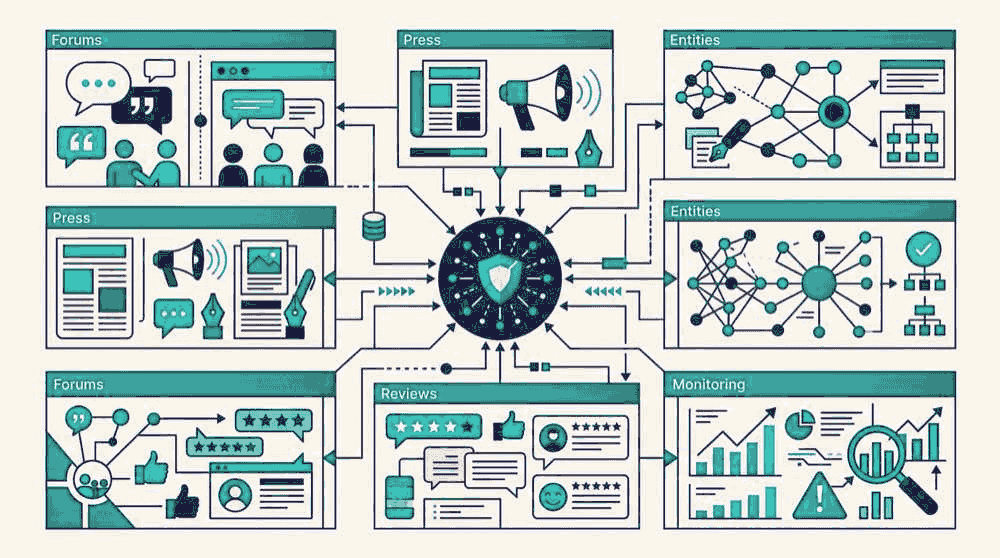
The five signals that drive AI recommendations break down like this. Citations — are you mentioned in the Reddit threads, Quora answers, and forum discussions that AI models already reference? Entity recognition — does the AI understand what your brand is, what category you’re in, and what makes you different? Review signals — do you have sufficient review volume and quality across the platforms AI models check? Press coverage — have authoritative publications written about you? Structured data — does your website’s schema markup help AI models parse your brand information correctly?
Here’s what the published v3 paper of our Outrigger AI Visibility Index study found (DOI 10.5281/zenodo.20076380). Domain Authority’s raw correlation with the composite visibility score was 0.337 on the Phase 1 sub-sample (n = 1,004) and 0.217 on the full sample (n = 2,200 businesses with non-null DA) (v3 §4.4), but once the off-page presence indicators are admitted as joint predictors, "the marginal contribution of Domain Authority is no longer distinguishable from zero in this sample" (v3 §4.4). Google review count’s raw correlation was +0.154, rising to +0.307 on a log scale (v3 Table 7, n = 2,554). Off-page presence (directories, Wikipedia, review platforms, Reddit and Quora mentions) correlates with being mentioned by ChatGPT, Claude and Perplexity (v3 Tables 2–4).
Here’s the critical insight: only 6% of brand mentions in training data translate into actual AI recommendations. Being mentioned isn’t enough. You need to be mentioned in the right places, in the right context, with the right frequency. A single press release on a wire service does almost nothing. But 20 authentic recommendations in high-authority Reddit threads that already rank on Google page one? That moves the needle dramatically. The gap between "mentioned" and "recommended" is where strategy lives — and it’s where most brands fail.
The Competitor Test: Who Is AI Recommending Instead?
Go back to those four AI tabs. This time, pay attention not to whether you appear, but to who does appear. Write down every brand that gets mentioned across your 5 test prompts. Count the mentions per brand, per model. What you’re building is a share of model map — a picture of who owns the AI recommendation layer in your category.
In most categories, you’ll find a stark power law. One or two brands dominate across all four models, appearing in 60-80% of responses. A second tier of 3-5 brands appears in 20-40% of responses. And then there’s everyone else — at 0-5%. The gap between the top brand and the fifth brand is usually enormous. In the music distribution category, for example, DistroKid appears in 72% of AI responses while the fifth-ranked competitor appears in just 11%. That’s not a competitive landscape — it’s a monopoly on AI-driven discovery.
The valuable insight isn’t just who’s winning — it’s why they’re winning. Look at the sources each AI model cites. Perplexity shows its sources explicitly, which makes this easy. For ChatGPT, ask it to cite sources. You’ll typically find that the winning brands have three things: heavy Reddit presence (people genuinely recommending them in threads), consistent entity data across platforms, and recent press coverage. They’re not winning because they spent more on ads. They’re winning because the internet’s consensus layer says they’re the answer.
The gap between where you are and where the leader is — that’s your opportunity. If your competitor appears in 45 high-authority Reddit threads and you appear in 2, you know exactly where to focus. If they have 4,200 reviews on Google and you have 23, the review pillar is your bottleneck. Map the gaps, prioritize by impact, and start closing them systematically. That’s what the 6-pillar audit framework is designed to do.
What to Do Next
You’ve now done something 95% of marketers haven’t: you’ve actually checked your AI visibility. You have a baseline. You know where you stand relative to competitors. The question is what to do about it.
The systematic approach is a 6-pillar AI visibility audit that scores your brand across AI Presence, Entities, Reviews, On-Page, Citations, and Press. Each pillar gets a score from 0-100, and the weighted composite gives you a single AI Visibility Score. We cover the full audit framework in The 5-Pillar AI Visibility Audit. If you want to understand the theory behind why AI models choose certain brands, read What Is GEO: The Complete Guide.
The fastest path to results is citation seeding — placing authentic, helpful responses in the Reddit threads, Quora answers, and forum discussions that AI models already reference. A well-executed citation seeding campaign builds durable third-party presence across the discussions retrieval models draw from over a 60- to 90-day cycle. The key is targeting the right threads: ones that already rank on Google, already get cited by AI models, and are genuinely relevant to your brand. Our audit-discover-seed-monitor cycle is designed to do exactly this at scale. We break down the exact playbook in our Citation Seeding Guide.
The metric you’re tracking through all of this is share of model — what percentage of relevant AI prompts result in your brand being recommended. Measure it weekly, across all four major models, with the same set of test prompts. It’s the north star metric for AI visibility, and it’s the number that directly correlates with AI-referred revenue. Read more about how to measure and benchmark it in Share of Model: The AI Marketing Metric.
If the 60-second test left you staring at competitors instead of your own brand, skip the guesswork: a free AI visibility audit scores where you actually stand across ChatGPT, Perplexity, Gemini, and Claude and emails you a prioritized gap list in several minutes.
Frequently Asked Questions
How do I check if ChatGPT mentions my brand?
Open ChatGPT and type a buying-intent prompt that a customer would use — something like "What are the best [your category] services?" or "Can you recommend a [your product type]?" Don’t use your brand name in the prompt. Check whether your brand appears in the response, whether it’s recommended or just mentioned, and which competitors appear instead. Repeat with 5 different prompt variations to get a reliable picture. Do the same across Perplexity, Gemini, and Claude for a complete view.
What percentage of brands are visible to AI models?
In our [Outrigger AI Visibility Index study](/research) (v3, DOI 10.5281/zenodo.20076380) across 2,729 businesses and 14 verticals in 4 markets, more than two-thirds of businesses (69.5% of 2,729, 95% CI 67.8–71.2%) are invisible in AI search — receiving zero mentions from any AI system they were tested on (Gemini and Google AI Overview were tested for a subset only). Only 30.5% were mentioned by at least one model.
Can I improve my AI visibility quickly?
The fastest lever is citation seeding — placing authentic, helpful responses in high-authority forum threads that AI models already reference. A targeted campaign builds durable third-party presence across the threads retrieval models draw from over a 60- to 90-day cycle. Compare entity consistency against your Day 0 baseline at Day 30, forum response citations at Day 60, and press coverage, review velocity, and composite AI Visibility Score at Day 90 and across subsequent quarterly re-audits.
Does AI visibility affect my Google rankings?
Indirectly, yes. The signals that drive AI visibility — brand mentions, entity consistency, review volume, press coverage — also strengthen your traditional SEO. More importantly, as Google integrates AI Overviews into 48% of search results, the same signals that make AI models recommend you also influence whether you appear in Google’s AI-generated answers. The two channels are increasingly interconnected.
Review Your AI Visibility Baseline
The free quick audit covers three core signal groups: Citations, AI Presence, and On-Page foundations. Review available findings and recommendations supported by the evidence the audit could verify.
Analyze your brandRelated Articles

The Outrigger AI Visibility Index: What Study 1 Said, and What the v3 Paper Retains

Share of Model: The AI Marketing Metric Replacing Share of Voice

How AI Models Decide Which Brands to Recommend (And Why Yours Might Not Make the List)
What Is Generative Engine Optimization (GEO)? The Complete Guide for 2026

The AI Visibility Audit: How to Score Your Brand Across 6 Pillars